How They Heard the “R”: Language, Identity, and Everyday Life in Kentucky, 1886
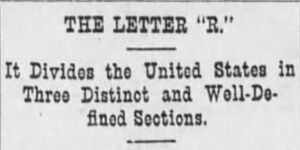
On June 29, 1886, readers of the Tri-Weekly Kentucky New Era in Hopkinsville encountered a short but thought-provoking column titled “The Letter ‘R.'” At first glance, it appeared to be a simple reflection on pronunciation. In reality, it offers a revealing window into how Kentuckians of the late 19th century understood language, identity, and social standing.
A Newspaper in Context
Published in Hopkinsville, the Tri-Weekly Kentucky New Era served Christian County and western Kentucky during the post–Civil War decades, a period of rebuilding, expanding literacy, and growing civic engagement. Like many regional newspapers of the era, it combined local reporting with editorial commentary and widely circulated reprinted material—a practice historians call exchange journalism.
Editors routinely borrowed short essays, poems, and opinion pieces from other newspapers, often without attribution. These exchanges allowed small-town papers to participate in national conversations about culture, education, and propriety. Articles on manners, elocution, and “correct” speech were especially common in the 1870s and 1880s, reflecting the era’s belief that refinement could—and should—be cultivated.
“The Letter ‘R'” fit squarely within this tradition. Its broad perspective and didactic tone suggest it was not locally written but clipped from a larger circulation paper, then reprinted for Hopkinsville readers.
The Meaning Behind a Single Letter
The column asserted that Americans could be divided into groups based on how they pronounced the letter “R.” Some speakers, it claimed, articulated the sound clearly in all positions; others softened or omitted it—particularly at the ends of words and before consonants. From this distinction, the writer drew conclusions about regional origin, education, and refinement.
Modern linguistics identifies this distinction as the difference between:
- Rhotic speech: Pronouncing the “R” in all positions (as in car, hard, farmer)
- Non-rhotic speech: Dropping or weakening the “R” when it follows a vowel (sounding like cah, hahd, fahmuh)
While the 1886 article presented these differences as matters of correctness, contemporary scholarship understands them as natural variations shaped by history, migration, and community identity. Non-rhotic speech, for instance, was associated with coastal elite centers like Boston, New York, and Charleston—and with British Received Pronunciation—while rhotic speech dominated inland regions, including much of the South and Appalachia.
Kentucky at a Linguistic Crossroads
In 1886, Kentucky occupied a unique cultural and geographic position. Settlement patterns had brought together influences from multiple regions:
- The Upper South, particularly Virginia, where non-rhotic speech had prestige among the planter class
- Scots-Irish migrants, whose strongly rhotic speech patterns shaped much of the Appalachian region
- Midwestern connections, as trade and migration linked western Kentucky to Ohio and beyond
As a result, speech in Kentucky was not uniform. Pronunciation varied by:
- County and community
- Rural versus town environments
- Family background, education, and social aspiration
The distinctions described in “The Letter ‘R'” would have been immediately recognizable to Hopkinsville readers—not as abstract ideas, but as part of everyday experience. A farmer from the countryside, a merchant in town, and a schoolteacher might each have spoken differently, and those differences carried social meaning.
Language and Social Aspiration
By the late 19th century, public education was expanding across Kentucky, and with it came increased attention to standardized English. The elocution movement, which peaked between 1870 and 1900, emphasized:
- Clear, “correct” pronunciation
- Consistent grammar
- Speech associated with educated, refined society
Elocutionists toured lyceums and Chautauquas, teaching Americans how to speak “with elegance and propriety.” By 1887, there were over 1,600 professional elocutionists in the United States, including Alexander Graham Bell, who opened schools for vocal training.
In this environment, language became more than communication—it became a marker of aspiration. The column’s suggestion that pronunciation could reveal a person’s standing reflects a broader cultural belief of the era: that speech could—and should—signal refinement. While modern linguistics rejects such prescriptive judgments, they were widely accepted and actively taught at the time.
A Circulating Idea
Although printed in Hopkinsville, “The Letter ‘R'” was almost certainly not a locally written piece. Its broad national perspective and instructional tone indicate that it was part of a widely shared body of editorial content circulating through American newspapers in the 1870s and 1880s.
Such articles allowed local papers to participate in national conversations about culture, education, and identity, bringing those discussions into small towns and rural communities. For readers in Christian County, the column connected their everyday speech to larger questions about progress, refinement, and belonging in postwar America.
A Genealogical Clue
For genealogists and family historians, this column offers something valuable but easily overlooked: cultural context.
It helps answer questions that records alone cannot:
- What ideas were circulating in the communities where ancestors lived?
- How were people taught to think about education, refinement, and self-presentation?
- What social expectations shaped everyday interactions in 1886 Hopkinsville?
A brief editorial like this reveals the cultural environment surrounding the names and dates found in census records, deeds, and wills. It reminds us that ancestors did not live in a vacuum—they read newspapers, attended school, heard sermons, and absorbed the social norms of their time.
Reading the Past More Fully
“The Letter ‘R'” is more than a commentary on pronunciation. It is a reflection of a moment in Kentucky’s history when language, education, and identity were becoming more closely intertwined.
For the readers of Hopkinsville in 1886, it was not merely about how to speak—it was about how to be understood in a changing world. For those studying Kentucky’s past today, it serves as a reminder that even the smallest details—a single letter, lightly printed in a newspaper column—can carry the weight of an entire culture.
Notes
- “The Letter ‘R.’” Kentucky New Era (Tri-Weekly), Hopkinsville, KY, June 29, 1886, p. 4. https://www.newspapers.com/image/173758699/
- Library of Congress, Chronicling America: Historic American Newspapers, https://chroniclingamerica.loc.gov/.
- Kentucky Digital Newspaper Program, https://kentuckynewspapers.org/.
- W. David Sloan and Lisa Mullikin Parcell, American Journalism: History, Principles, Practices (Jefferson, NC: McFarland, 2002).
- William Labov, The Social Stratification of English in New York City, 2nd ed. (Cambridge: Cambridge University Press, 2006).
- William Labov, Sharon Ash, and Charles Boberg, The Atlas of North American English (Berlin: Mouton de Gruyter, 2006).
- Oxford English Dictionary, s.v. “rhotic,” “non-rhotic.”
- Lynda Mugglestone, Talking Proper: The Rise of Accent as Social Symbol (Oxford: Oxford University Press, 1995).
- Noah Webster, An American Dictionary of the English Language (New Haven: S. Converse, 1828).
- Richard W. Bailey, Nineteenth-Century English (Ann Arbor: University of Michigan Press, 1996).
- Kentucky Historical Society, publications and educational resources, https://history.ky.gov/.
- Stephen Aron, How the West Was Lost: The Transformation of Kentucky from Daniel Boone to Henry Clay (Baltimore: Johns Hopkins University Press, 1996).
- University Press of Kentucky, regional historical publications.
- Joan C. Beal, English in Modern Times: 1700–1945 (London: Arnold, 2004).
- Murray State University. “The Tri-Weekly Kentucky New Era, June 29, 1886.” Kentucky New Era Tri-Weekly. Digital Commons. https://digitalcommons.murraystate.edu/
- University at Buffalo. “The Elocution Movement – A History of Speech.” A History of Communication Disorders. Accessed April 8, 2026. https://ubwp.buffalo.edu/history-of-cds/19th-century/elocution/.