
This Thanksgiving, bring more than food to the table—bring the memories, traditions, and names behind every dish.
A country ham hangs in the dim rafters of a smokehouse. Cornbread browns beside the hearth. Strings of drying beans loop across a porch, while blackberry preserves hold a little of summer against the coming cold.
These are the textures of Kentucky’s food history: salt, smoke, wood ash, and the sweetness saved for another season. They are also the beginnings of stories that may still live at your family’s table.
This Thanksgiving, listen for them.
 Who always brought the jam cake? Whose hands taught yours to shape the biscuits? Is the cornbread dressing recipe written on a faded card, or does someone still make it by feel? Before the plates are cleared, ask where those dishes came from—and who carried them from one generation to the next.
Between 1700 and 1900, Kentucky cooking took shape from Native food knowledge, the labor and expertise of enslaved Black cooks, farm families’ ingenuity, and immigrant traditions.
An old handwritten “receipt” for jam cake is more than a recipe. A penciled instruction about curing pork is more than a household reminder. Each offers a glimpse of a working kitchen: what grew nearby, what money could buy, whose hands prepared the food, and what a family hoped to carry through winter.
Not every dish discussed here belongs to a Thanksgiving menu. Together, however, they offer a way to look more closely at the foods we gather around—and the people we remember when we eat them.
The Frontier Table, 1700–1800
Before Kentucky had a recognizable regional cuisine, it had the ingredients—and Indigenous knowledge that helped newcomers use them.
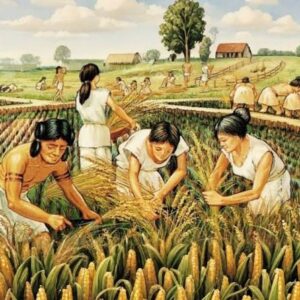 Native peoples hunted in Kentucky and cultivated corn, beans, and squash along its rivers. Settlers drew heavily on those food traditions. Corn became hominy, parched kernels carried on a journey, and hoecakes browned on a board or nestled near the coals.
The surrounding woods supplied deer, bear, turkey, and squirrel. Bison also furnished meat, though they were nearly gone from Kentucky by the 1790s. Pawpaws, persimmons, nuts, maple sugar, and the first tender greens of spring brought sweetness and variety to a diet shaped by the seasons.
Keeping food mattered as much as finding it. At places such as the Blue Licks, salt boiled from spring water provided an essential means of preserving meat.
But corn was the foundation.
It could grow among girdled trees without a fully plowed field, and its harvest fed people, hogs, and horses alike. Treated with lye made from wood ash, the kernels became hominy—a lasting Kentucky staple.
The frontier table was not a daily feast of wild abundance. It depended on knowing what to gather, when to plant, and how to save enough for the lean weeks ahead.
The Farm Kitchen, 1800–1860
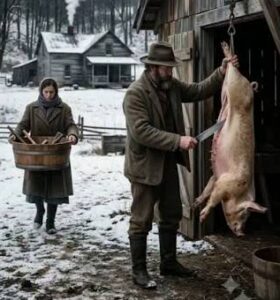 After Kentucky became a state in 1792, the hog steadily displaced wild game as the farm kitchen’s mainstay.
Hogs ranged through the woods, fattening on acorns and nuts before being finished on corn. Drovers pushed large herds over mountain roads toward eastern markets. At home, the first hard freeze signaled the season for hog killing—and a concentrated burst of work.
Fresh pork became sausage. Scraps went into souse. Fat was rendered into lard, leaving crisp cracklings behind. Hams were packed in salt, smoked over hickory, and set aside to age.
Kentucky’s celebrated country ham began with the urgent business of keeping meat edible.
The garden and orchard demanded their own rounds of work. Beans, cabbage, greens, and sweet potatoes filled household meals. Apples cooked down into thick butter or became cider. Sorghum arrived in the 1850s and took a growing place among everyday sweeteners.
Preservation gave the kitchen its rhythms: slicing, stirring, salting, smoking, drying, and pickling. Glass-jar canning spread after the Mason jar’s patent in 1858; before then, families relied heavily on older methods to bridge the seasons.
At the Shaker communities of Pleasant Hill and South Union, detailed kitchen records preserved something easily lost elsewhere: the planning and labor behind a well-stocked pantry.
As you gather family recipes this Thanksgiving, look beyond the finished dish. Ask about the garden, the orchard, the preserving kettle, and the shelves where jars once stood. A recipe for apple butter may open a conversation about an entire season’s work.
Bluegrass Kitchens: The Hands Behind the Table
The polished surface of Kentucky hospitality often concealed the labor that made it possible.
By 1860, roughly 225,000 people—about one in five Kentuckians—were enslaved. Many lived and worked on Bluegrass farms. Enslaved Black cooks helped shape the dishes later celebrated as Kentucky tradition, yet their names rarely appeared beside the recipes.
In wealthier households, cooking often took place in a separate building behind the main house. There, enslaved cooks managed fires, judged heat, roasted meats, baked biscuits, tended preserves, and produced elaborate cakes for the enslaving family’s table.
They also faced the work of feeding their own families. Weekly rations of cornmeal and salt pork were stretched with garden produce, fish, and gathered foods. The contrast was stark: an abundant table in one household could depend on people working to make limited provisions last in another.
Lettice Bryan’s The Kentucky Housewife, published in 1839, contains more than a thousand recipes and records the ambitions of the planter’s table. It does not give equal visibility to everyone whose skill sustained that table.
Reading an inherited recipe means looking beyond the name at the top of the page. Who tended the fire? Who beat the biscuit dough? Who knew, without a thermometer, when the cake was done?
Gratitude at the table can include an honest reckoning with that work. Where names are known, preserve them. Where they are missing, acknowledge the gap rather than allowing the labor to disappear with it.
One State, Many Tables
Kentucky’s food changed with the ground beneath people’s feet.
In the eastern mountains, families worked small, steep plots and often had little cash. Drying, foraging, and making careful use of a harvest were central to the household economy. Strings of shuck beans turned a summer crop into winter food.
In the Bluegrass, rich limestone soils supported larger farms, greater access to purchased goods, and, among wealthy households, formal entertaining.
Farther west, rivers supplied fish and connected communities to trade. Louisville and other Ohio River towns also carried the influence of German food traditions.
These were overlapping food traditions, not rigid borders:
| Region | Foods and traditions |
| Eastern mountains | Cornbread, soup beans, shuck beans, greens, wild foods |
| Bluegrass | Country ham, beaten biscuits, cakes, bourbon |
| Pennyroyal | Country ham, garden vegetables, barbecue |
| Western rivers | Barbecue, catfish, other river fish |
| Ohio River towns | German sausage, sauerkraut, rye bread, beer |
There was never just one Kentucky table. A mountain household’s supper and a wealthy Bluegrass family’s dinner might share corn and pork while revealing very different circumstances.
That variety offers another starting point for Thanksgiving conversation: Where did your family’s recipes begin? Write down the places named by relatives—a county, a river town, a farm, or a kitchen they remember visiting as children. Let the family’s own accounts guide the story rather than assuming a dish belongs to only one place.
Signature Dishes—and the Work Inside Them
Kentucky’s familiar dishes carry the marks of the kitchens that produced them: the smokehouse, the preserving kettle, the long simmer, and the hard-used worktable.
| Dish | Description |
| Burgoo | Slow-simmered meat and vegetable stew |
| Country ham | Salt-cured, smoked, aged pork |
| Beaten biscuits | Small, firm biscuits from hand-beaten dough |
| Spoonbread | Soft cornmeal pudding |
| Jam cake | Spiced blackberry-jam cake with caramel icing |
| Chess pie | Sugar, butter, and egg custard pie |
| Shuck beans | String-dried green beans cooked with pork |
| Barbecue | Pork or mutton cooked over hickory coals |
Some of these foods conceal remarkable effort. Beaten biscuits could require half an hour or more of pounding—a task often assigned to enslaved cooks. Their tidy appearance at the table gave little hint of the exertion behind them. Jam cake joined two seasons in a single slice: summer’s blackberries, preserved in jam, returned in a spiced cake made weeks before Christmas.
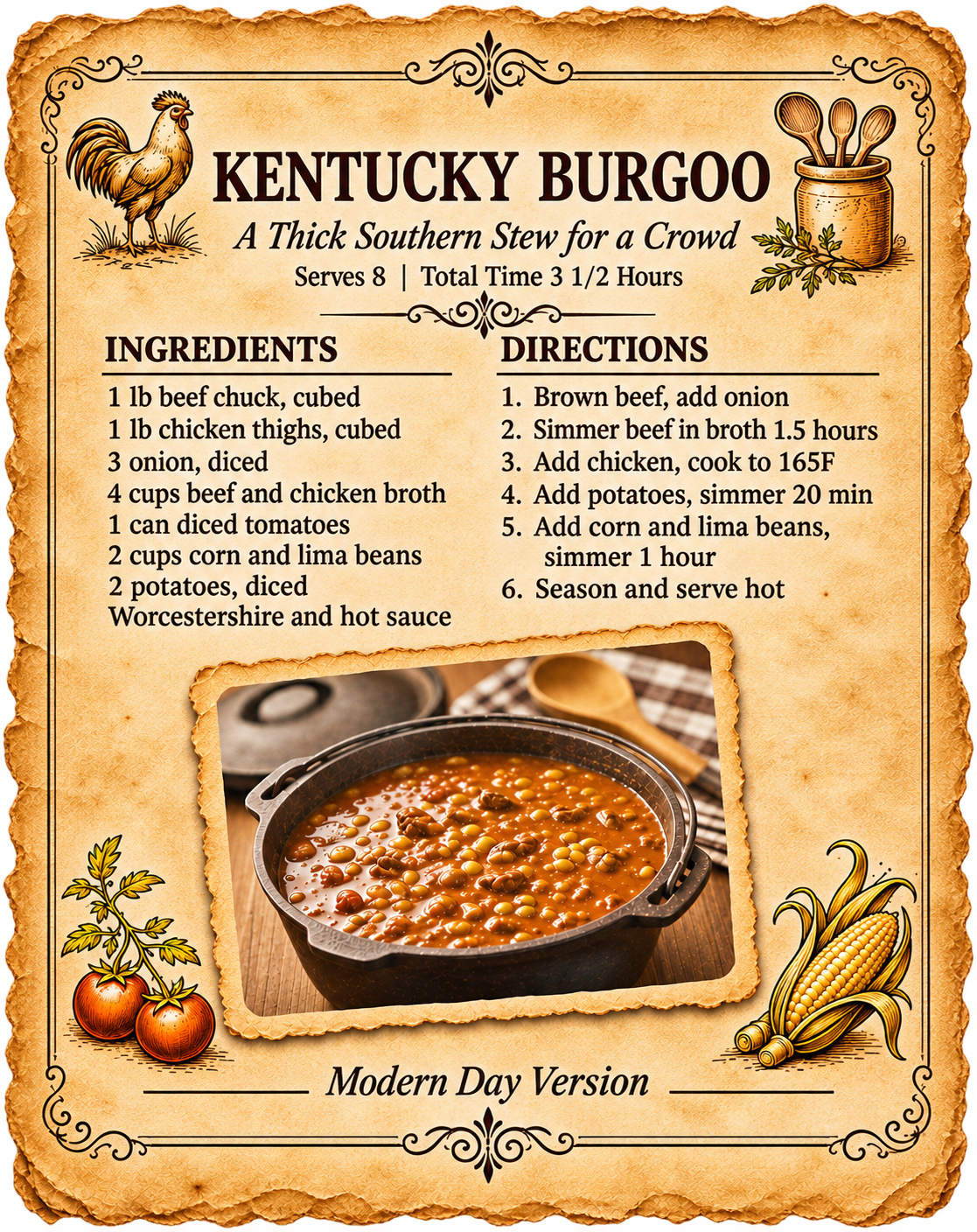
Spoonbread grew from older preparations known as “batter bread”; its now-familiar name became common only near 1900. Bourbon, meanwhile, turned corn into a portable product and found its way into cakes, sauces, and the mint julep. Not every appealing origin story holds up equally well. Accounts that give burgoo a single inventor belong to the realm of legend rather than settled history. The stew’s place in Kentucky cooking is clearer than the identity of whoever first stirred a pot. Family stories deserve the same thoughtful treatment. Keep the colorful tale, but label it a family recollection when you can’t confirm its details. A story does not have to become proven history to be worth preserving.
War and a Changing Pantry, 1861–1900
The Civil War emptied smokehouses, depleted stores, and stripped farms of livestock. Scarcity changed the taste of everyday life. Sorghum substituted for scarce sugar; roasted grains stood in for coffee.
Emancipation changed the terms of kitchen labor. Many Black cooks continued working in private homes, hotels, and restaurants, now for wages. Meanwhile, railroads such as the Louisville & Nashville helped bring more white flour, baking powder, and refined sugar into Kentucky kitchens. Access remained uneven, and change came more slowly in the mountains.
New ingredients and leaveners made fluffy biscuits and tall layer cakes easier to produce. Older recipes acquired new versions as cooks folded store-bought goods into familiar methods.
Printed community cookbooks helped preserve—and assign names to—these dishes. Housekeeping in the Blue Grass, published in 1875 by the ladies of the Presbyterian Church in Paris, Kentucky, gathered recipes under local women’s names.
Many surviving family recipe collections date from this late-century world, where inherited kitchen knowledge met printed instructions and an expanding market in packaged ingredients.
The pantry was changing. So was the written record of who received credit for feeding a household.
This Thanksgiving, Gather the Stories
Before everyone leaves the table, choose one dish and ask someone to tell its story.
Begin with a question that invites a memory rather than a measurement: “Who made this when you were little?” Then make room for the answer—the kitchen, the occasion, the person, and the details that do not appear on the recipe card.
Use these questions to guide the conversation:
- Who taught you to make this dish?
- What did that person do that the written recipe leaves out?
- Was it everyday food or something saved for holidays?
- Where did the ingredients come from?
- Has the recipe changed? What did you substitute, add, or stop using?
- Which bowl, pan, or utensil do you remember?
- Who else helped prepare the meal?
- Whom do you think of when you taste it?
Listen for the small details: the chipped mixing bowl, the flour-dusted apron, the handwritten correction, the good-natured argument over how much sage is enough.
Ask permission before recording a conversation or sharing a personal story. If relatives remember things differently, keep both accounts and note who told each one. The goal is to preserve their voices, not force every memory into a single version.
Photograph the recipe card. Keep the crossed-out quantities and margin notes visible. Those marks are part of the record, too.
Following the Recipe Beyond the Table
A family conversation can be the beginning of a larger search.
Read recipes alongside other household and community records:
- Family letters and diaries
- Probate inventories listing kitchen equipment and livestock
- Census agricultural schedules from 1850 to 1880
- Store ledgers and church cookbooks
- Interviews with older relatives
The Kentucky Historical Society and the Filson Historical Society are useful starting points for that research.
Expect old recipes to leave things unsaid. “Butter the size of an egg,” “a teacup of sugar,” and “a quick oven” belonged to kitchens where experience supplied the missing measurements.
If you recreate an inherited dish, keep the original wording intact and record your modern measurements and observations separately. Mark an adaptation as your version rather than silently changing the old one.
Look beyond ingredients as well. Ask what the household grew, what it bought, what it could afford—and who did the cooking.
What the Table Remembers
Kentucky’s best-known foods grew from practical demands: preserve the harvest, stretch the pantry, use what the land offered, and feed people through winter.
But necessity alone does not explain the care lavished on them. A ham could be preserved well or badly. A cake could simply fill a plate—or carry the remembered flavor of summer blackberries into December. Skill made the difference, even when the historical record failed to name the person who possessed it.
This Thanksgiving, make room for those people in the conversation. Say their names. Ask about their work. Save the recipe and save the memory alongside it. Long after the dishes are washed, and the last chair is pushed beneath the table, those stories will be worth keeping.
Sources
- Berry, Wes. The Kentucky Barbecue Book. Lexington: University Press of Kentucky, 2013.
- Bryan, Lettice. The Kentucky Housewife. Cincinnati: Shepard & Stearns, 1839.
- Clark, Thomas D. A History of Kentucky. First edition, 1937.
- Clark, Thomas D., and F. Gerald Ham. Pleasant Hill and Its Shakers. 1968.
- Egerton, John. Southern Food: At Home, on the Road, in History. New York: Knopf, 1987.
- Flexner, Marion. Out of Kentucky Kitchens. New York: Franklin Watts, 1949.
- Kleber, John E., ed. The Kentucky Encyclopedia. Lexington: University Press of Kentucky, 1992.
- Klein, Maury. History of the Louisville & Nashville Railroad. New York: Macmillan, 1972.
- Ladies of the Presbyterian Church, Paris, Kentucky. Housekeeping in the Blue Grass. 1875.
- Lewis, R. Barry, ed. Kentucky Archaeology. Lexington: University Press of Kentucky, 1996.
- Lucas, Marion B. A History of Blacks in Kentucky, Vol. 1: From Slavery to Segregation, 1760–1891. Frankfort: Kentucky Historical Society, 1992.
- Lundy, Ronni. Victuals: An Appalachian Journey, with Recipes. New York: Clarkson Potter, 2016.
- Mason, John L. Improvement in Screw-Neck Bottles, Jars, &c. U.S. Patent No. 22,186, November 30, 1858.
- Sohn, Mark F. Appalachian Home Cooking: History, Culture, and Recipes. Lexington: University Press of Kentucky, 2005.
- U.S. Census Office. Population of the United States in 1860. Washington, DC, 1864.
- Veach, Michael R. Kentucky Bourbon Whiskey: An American Heritage. Lexington: University Press of Kentucky, 2013.