How we had vacation fun while learning about our family history in Kentucky
Part 3 of a 3-part series. Click here for Part 1 and Part 2.
Early Roots in Harrodsburg
We drove a circuitous route from Lexington to Harrodsburg on Day 7. We first wanted to visit the Kentucky History Center in Frankfort, especially to see its new exhibition “Revolution to Statehood: Kentucky’s Founding in History and Memory.” It did not disappoint. An expert guide led us through the exhibit, explaining early settlements and stations, domestic life on the frontier, and the ever-present danger of native American attacks.
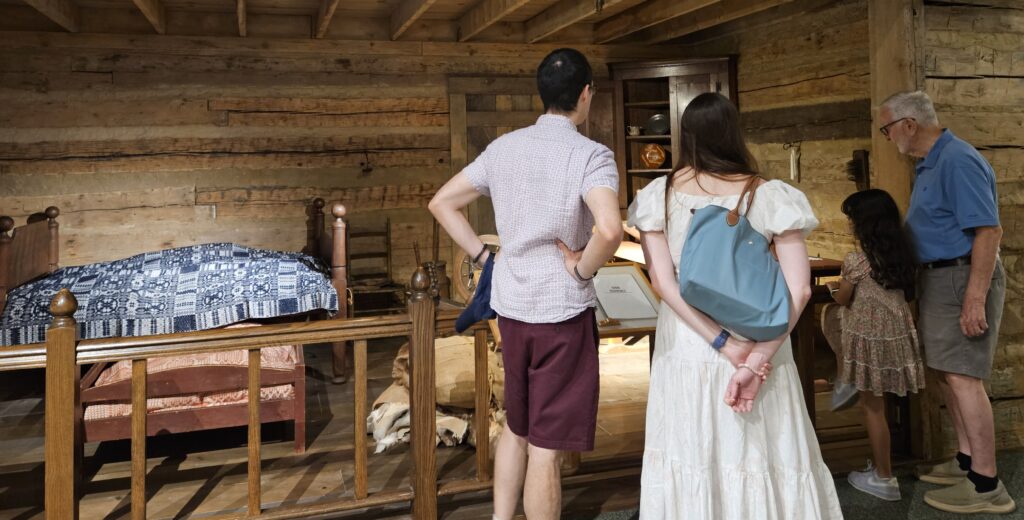
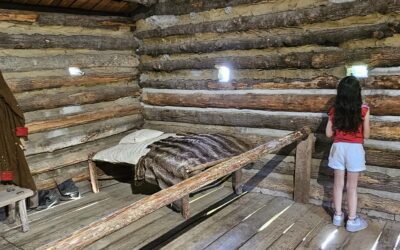
LOG CABIN LIFE — My family and I inspect a model of domestic life in a log cabin exhibited at the Thomas D. Clark Center for Kentucky History in Frankfort.
Relics, maps, historic paintings, and attractive information boards illustrated this history. Some reminded us of earlier stops on our family history tour. One exhibit describes George Rogers Clark’s Wabash Campaign in which Vincennes was captured (see Part 1), as well as his full military career and later life. Another exhibit features Daniel Boone and his many actions and contributions to Kentucky in the Revolutionary War era.
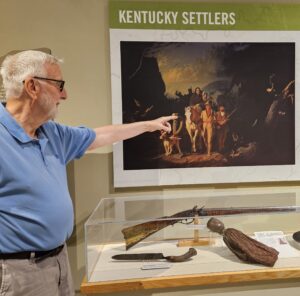
FIRST FAMILIES – In September 1775 four men came through Cumberland Gap with their wives and children as the first to settle here. As I tell this story, I fancifully point out my ancestor Hugh McGary with his beaver hat, a rifle across his chest, and next to Boone in this George Bingham painting.
Among the paintings on display was one by George Caleb Bingham titled Daniel Boone Escorting Settlers Through the Cumberland Gap. I have fun with this painting, imagining the man walking beside Boone to be Hugh McGary Sr., my fifth-great-grandfather. When Bingham painted this in 1851-52, he hardly could have known that Hugh had a preference for beaver hats – but there he is in a beaver hat. No matter, it is well documented that in September 1775 the first four families to cross Cumberland Gap into Kentucky were those of Hugh McGary, Daniel Boone, Thomas Denton, and Richard Hogan. (1)
Another part of the museum depicts Kentucky’s full evolution into the modern era, including coal mining, the manufacturing of Corvettes and more. I was happy that my granddaughter seemed to enjoy the history center or at least found it pleasingly tolerable.
After a late lunch with ice cream, of course, we resumed our drive toward Harrodsburg. Our actual destination was the Shaker Village of Pleasant Hill, where we spent two nights. True to our goal of keeping all things historical, our accommodation here was in the Old Ministry’s Shop, built in 1813. The building was all ours, with two bedrooms upstairs and a tiny kitchen and a roomy living area with a sofa bed downstairs. My granddaughter took joy in laying first claim to where she would sleep.
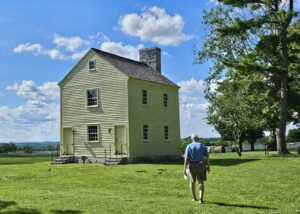
OLD MINISTRY’S SHOP — As I walk to our 1813 “home” at the Shaker Village, I feel a sense of the past and a tranquility in the natural world. Two-thirds of the Village’s 3,000 acres are preserved forests, wetlands, and native prairies.
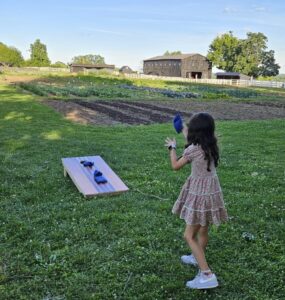
Time To Play — My granddaughter tries to best her dad with beanbag throwing in a cornhole game. Kids can play on the lawn next to an outdoor patio with live music, food, and drinks in the evening.
On the morning of Day 8, Rita and I got up before the others for an exciting hike. Descriptions and old maps suggested that the site of Hugh McGary’s Station might have been nearby, and we wanted to check it out. After 45 minutes amid thick woods and limestone outcroppings, we did reach the Shawnee Run watercourse for the station, but I later learned that its site at Shawnee Springs was still five miles away. The hike experience, however, still gave me a high. The thought that this woodsy, wild area today lies in some measure as it was 250 years ago is mind-blowing. As I think of other historical spots that now are parking lots or shopping centers, I find this amazing!
We returned to join the family for breakfast at the Shakers’ Trustees’ Office (built 1839), which has been renovated as a restaurant. Today would be our big day in Harrodsburg, including attending the once-a-year “Settlement and Raid” reenactment at Old Fort Harrod State Park.
When we arrived at the park, the broad landscape surrounding the fort was covered with tents pitched by reenactors who actually had been sleeping and cooking on the grounds. Dressed as pioneers, these folks were using and demonstrating pioneer tools, firearms, and all manner of paraphernalia of the era. We met an 11-year-old pioneer boy who had assembled his own rifle and other pioneer accessories. Talking with these reenactors definitely advanced our backwoods education.
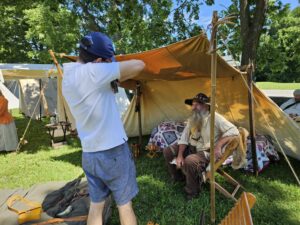
OLD-TIMER CAMPS — My son-in-law lifts a Kentucky long rifle as its owner tells him how to hold and aim it. Other campers explained how a myriad of edibles were dried for the winter and how jewelry was made with bone, hide, and seeds.
The original Fort Harrod, like its full-scale replica here, had two-story blockhouses on three of its corners. The NW corner, bordered by a spring, had another cabin rather than a blockhouse. In many of the fort’s 18 cabins, reenactors demonstrated skills much as those in the outside tents. We watched a woman tediously making cloth on a loom, a blacksmith pounding hot metal on an anvil, musicians playing period instruments, and more.
The time was now drawing nigh for day’s main attraction – the native American raid on the fort. As background, native Americans largely accepted the very earliest adventurers who came into Kentucky, or at least they shared an uneasy truce. However, with the outbreak of the Revolutionary War, the British persuaded many tribes to join them in fighting the Kentucky settlers. The reenactment is based on the fort’s success in thwarting continuous raids throughout May and June of 1777.
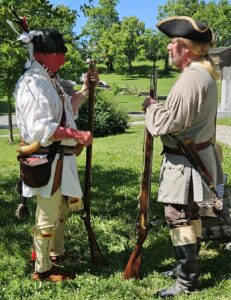
DIALOGUE BEFORE BATTLE–Native Americans and Kentucky settlers had serious differences to discuss. Their peaceful prewar dealings had unraveled as tribes joined the British to fight. Reminding them of past relations, settlers asked the native Americans to abandon the attack on Fort Harrod.
Rita and I moved closer to watch the raid. My daughter’s family stayed more distant, concerned about our 8-year-old’s exposure to violence, especially tomahawking, albeit simulated. Soon they warmed to the experience and moved up closer. The raid was both exciting and educational.
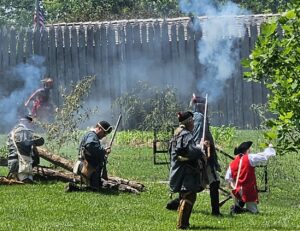
BATTLE ERUPTS–An indigenous warrior runs along the fort’s wall looking for an entry point as firing by Scottish Highlanders led by a British officer distracts the fort’s defenders.
We still wanted to see inside a blockhouse before leaving the park. Of course, we chose the corner where George Rogers Clark had his headquarters downstairs and his living area above. He oversaw Fort Harrod’s construction in 1775 and maintained his base there until May 1778 when he shifted his headquarters to the Falls of the Ohio. The accommodations were simple and austere, but adequate at the time for the commander of the Kentucky Militia. Also, his headquarters made a nice bookend for our tour, having begun a week earlier at the George Rogers Clark National Memorial in Vincennes, Indiana.
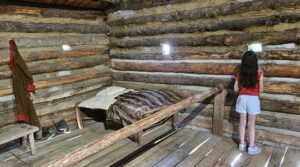
GENERAL CLARK’S QUARTERS--My granddaughter peers through a gunport in George Rogers Clark’s room above his headquarters in the SE corner blockhouse.
The next day we drove our daughter’s family to the Lexington airport for their flight home. I pointed our minivan toward home in southern Indiana. We detoured to visit a cemetery in Vine Grove, Kentucky –of course!
[1] Collins, Lewis. History of Kentucky, Vol. 1 (Covington, Kentucky: Collins & Co., 1874 [revised and expanded version by author’s son, Richard H. Collins, of Lewis’ original 1847 work]), pp, 18, 511.