How to have family vacation fun while learning about Kentucky history
Part 2 – Parks for Fun and Facts. This is the second part of a three-part series. Click here to see Part 1.
Day 4: Mammoth Cave National Park
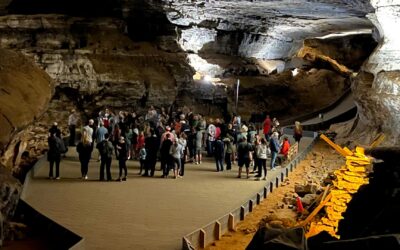
After three intense days immersed in family history, we planned to slow down and shift a bit into genuine vacation mode. My daughter wanted her husband and daughter to see Mammoth Cave, so this was our stop for Day 4. We had reserved the Historic Tour, of course, and also took the Frozen Niagara Tour. Both were fascinating.
My granddaughter cheered her smaller stature as we ducked to dodge low cave passages and squeezed through Fat Man’s Misery. She also surprised us by her familiarity with the cave environment. This came from her building worlds in the popular computer game Minecraft, whose underground environments have some matching features. She explained, for example, that in Minecraft she encounters “dripstone” (aka stalactites and stalagmites). Kids do learn from computer games.
Here’s a tip if you plan to visit Mammoth Cave. Their tours change quarterly. You cannot book a tour more than three months in advance. Then they fill up fast. Near their tour changeover date, I monitored their website daily to snag the Historic Tour on the day and time we needed. Also, we rented one of the new family cabins, which allowed our group of five to share three bedrooms, two bathrooms, and a well-equipped kitchen. An Instacart delivery enabled my daughter and wife to fix dinner, breakfast, and lunch in our cabin, which also had a screened-in porch.
Day 5 revealed a surprising wrinkle in our trip planning, which was done out of state.
We failed to account for the time zone change that splits the Commonwealth. Travelers who don’t live in Kentucky take note. Roughly the western third of the state is on Central Time, and the rest follows Eastern Time, including Louisville and Lexington. We left Mammoth Cave heading for Lexington for lunch with cousins. We’d planned a stop in Hodgenville at the Abraham Lincoln Birthplace National Historical Park. We soon realized that it was an hour later in Lexington, and our cousins planned to meet us there at noon. We were disappointed that our time-planning error caused us to miss seeing the log cabin where Lincoln was born.
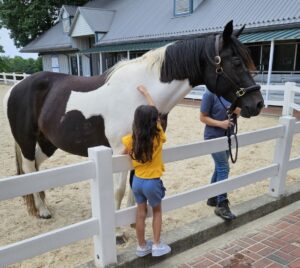
EQUINE EMPATHY – My granddaughter pets Winter’s Willow, an Oldenburg mare at Kentucky Horse Park. The breed is friendly and cooperative. The park is dedicated to human-horse relationships.
At noon we met two cousins at Kentucky Horse Park, a tourist destination that is a large horse farm with elements of a theme park. What’s a tour of Kentucky without a bit of horse history? We met some champion thoroughbreds, horses of many breeds, and learned about Kentucky’s horse culture. My granddaughter was thrilled to ride a pony, and we all enjoyed a horse-drawn trolley tour around the property. Also, the Kids Barn offered interactive activities for children.
At these vacation venues, I tried to tell a family story connected to our activity. Some were a stretch – or unsubstantiated family lore. Horses and horse racing, however, opened the barn door for a solid story. My fifth great-grandfather, Hugh McGary Sr., loved horse racing and, some say, was a notorious gambler. In May 1783, he was charged with betting on a race at Haggin’s Race Path, near Harrodsburg, in violation of Virginia law. McGary was found guilty and fined. The Lincoln County Court also deemed him an “infamous gambler” and said, “he shall not be eligible to any office of trust or honor within this State.”[1] (Despite this, McGary was reinstated as a Lincoln County Court Justice the next month.) As I see the betting at today’s horse races, I marvel at how the times have changed.
Day 6: Blue Lick Battlefield
The next morning, we drove 45 miles northeast from Lexington to visit Blue Licks Battlefield State Park. The Battle of Blue Licks, August 19, 1782, was the last battle of the American Revolution in Kentucky, occurring after Great Britain had surrendered at Yorktown. British rangers from their continuing base in Detroit were supporting, if not leading, the indigenous warriors. Major Hugh McGary Sr. was an officer in Colonel Daniel Boone’s militia–one of three militia groups in the battle. Seventy-two Kentucky settlers were killed in an ambush by native Americans at this site. [2]
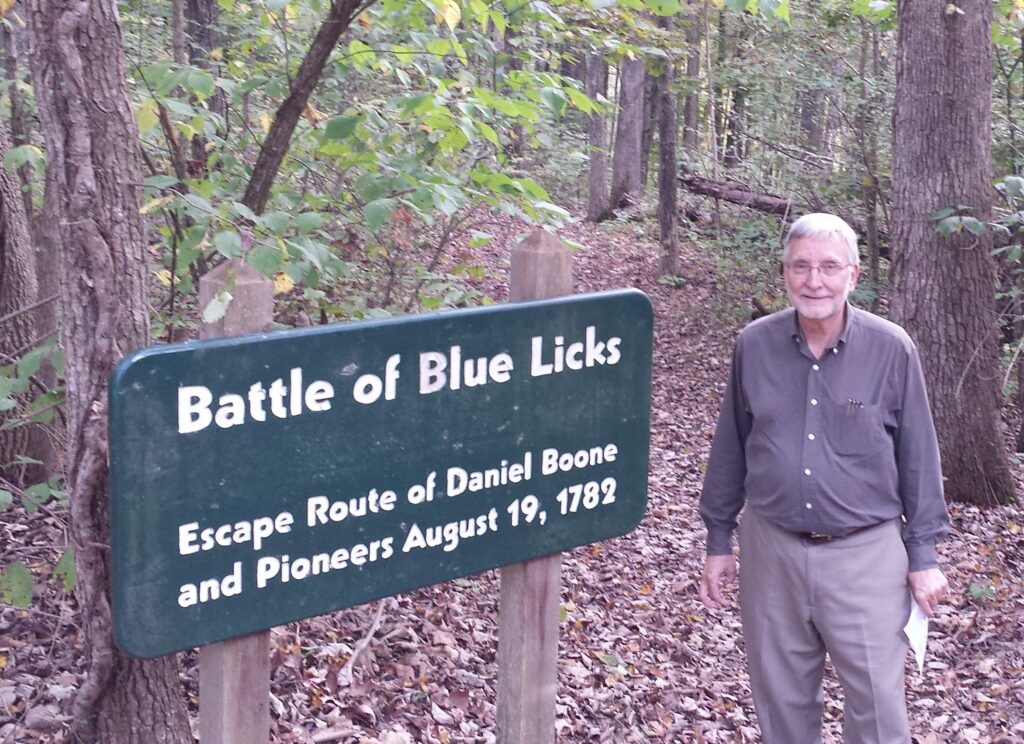
ESCAPE ROUTE – Some militiamen fled the massacre along routes back to and across the Licking River. Visitors can follow this well-marked route. I am standing at its trailhead.
We walked up the slope where the battle occurred, noting the deep ravines on both sides where the native Americans had waited in ambush. This was a moving experience, though I downplayed the violence out of deference to my granddaughter’s sensibility.
The role of Major Hugh McGary Sr. in precipitating the Battle of Blue Licks has been addressed by numerous historians. Most 19th-century historians blamed him, citing his infamous line, “All ye who are not cowards, follow me.” However, Colonel Daniel Boone omitted specific blame toward McGary in official letters to the Governor of Virginia and regretted his own acquiescence in McGary’s appeal. General George Rogers Clark, the overall commander of the Kentucky militia forces, suffered severe public backlash for failing to protect the frontier.[3]
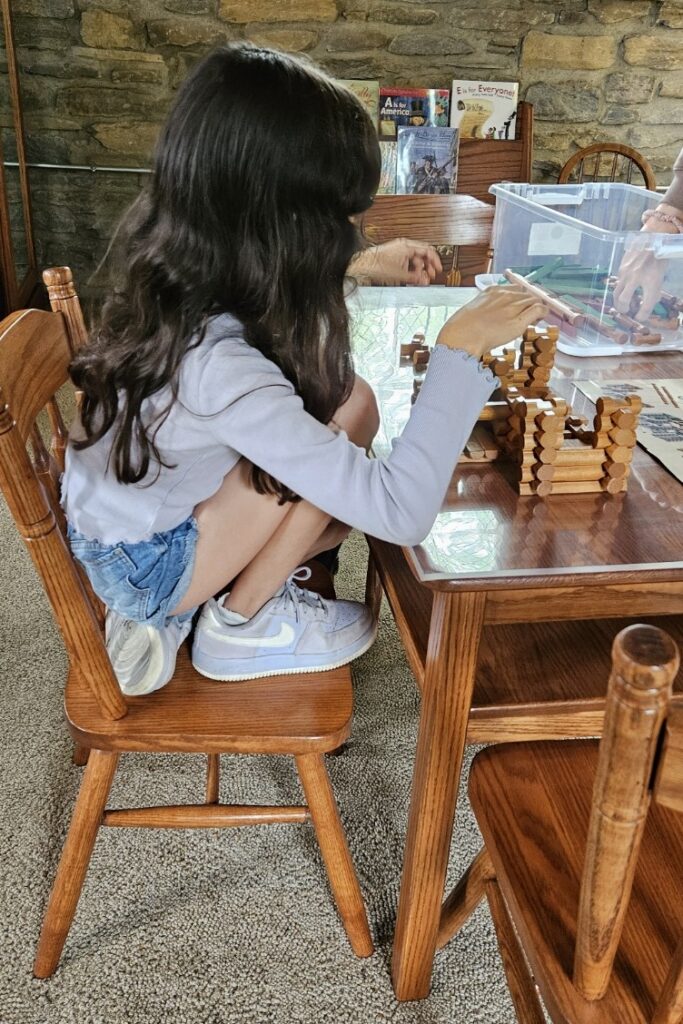
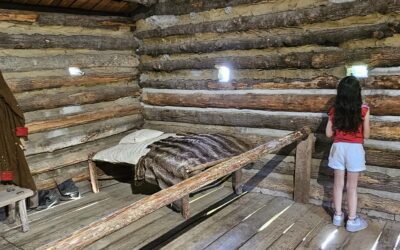
LINCOLN LOGS – My granddaughter builds a model log cabin in an activity room at the Blue Licks Battlefield State Park’s Pioneer Museum.
We also visited the Park’s Pioneer Museum, which has a collection of historical artifacts from the site and of the pioneer era. We saw period firearms, spinning wheels, salt-making kettles, and more. Artifacts also include bones of prehistoric animals that roamed this area. Mastodons were here, attested to by a 100-pound mastodon tusk unearthed in 1945.
The Pioneer Room in the museum offers hands-on learning resources for children. At the Dress-Up Station, pioneer-style clothing is available for kids to try on. My granddaughter enjoyed the Play Table with art supplies, tactile games, and construction toys. Her escape from the Blue Licks battle came through playing with Lincoln Logs.
In Part 3, we will go farther back in time with our visit to Harrodsburg, the first settlement in Kentucky. We arrived on schedule to experience a reenactment of a native American raid on Fort Harrod.
[1] Lincoln County, Virginia Order Books (1781-1784).
[2] Trowbridge, John M., “‘We are all slaughtered Men’: The Battle of Blue Licks,” Kentucky Ancestors, v42-2, 2006, pp. 59-67; image copy, Kentucky Historical Society (https://www.kyhistory.com/digital/collection/p16602coll3/id/68 : accessed 8 July 2026).
[3] Ibid.